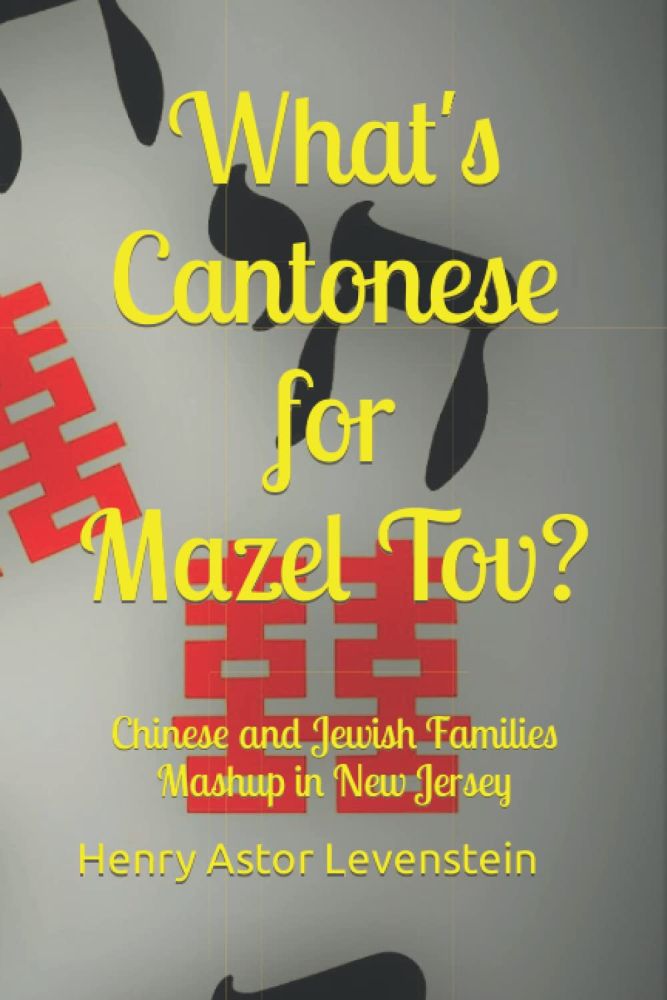
Chinese and Jewish Families Mashup in New Jersey
A Jewish girl (my daughter) named Sara marries a Chinese man whose last name is Lee, making her married name just like the famous brand of baked goods. At about the same time, my nephew Yakov, raised as an Orthodox Jew in Lakewood, NJ, gets his secret Chinese girlfriend pregnant and they marry. So now my family of NY metro Jews with roots in Lithuania and Poland merges into Chinese families with roots in Guangdong and Shanghai.
It’s a merger (or clash) of ancient cultures. The Chinese always arrive early. The Jews always arrive late. The Jews hug and kiss you with hardly any provocation, even if you’re the plumber who’s just replaced a faucet. A Chinese son shakes hands with his mother–on Mother’s Day.
The Orthodox and Secular Reform wings of the family can’t figure each other out, either. You’ll see.
All the characters are nice people. Solid citizens with good careers and lovely homes. There isn’t even a lot of political disagreement. Yet we don’t know what to do with each other. It’s Fresh Off the Boat meets The Goldbergs with a side of Shtisel,
But it works, mostly.
How? Let me tell you. . .
Available in Paperback and for Kindle
A FOUR STAR REVIEW of the book (okay 4 out of 5, but still…)
What’s Cantonese for Mazel Tov?: Chinese and Jewish Families Mashup in New Jersey by Henry Astor Levenstein
Book Review by Jerry Waxler, Author of Memoir Revolution
4 out of 5 stars
In most memoirs, the main challenge of the hero is obvious. For example, in a coming of age memoir, the character must acquire the skills to go from toddler to adult. But trying to figure out the main challenge in What’s Cantonese for Mazel Tov turned out to be half the fun. And in going on this strange journey with the author of reading it. I spent a lot of time wondering, “Where is this book going?
The “psychosocial” power of the memoir
The high stakes of most memoirs takes place on a psychological plane. Each book poses the question, “How does this character grow emotionally?” In What’s Cantonese for Mazel Tov, the memoir is not so much about how the main character grew psychologically within himself. He’s pretty much the same guy at the end as he was at the beginning. The amazing journey that I take when reading the book is the joining of two families.
Yes, the pace is slow, in comparison with the modern thriller, with chase scenes and martial arts, the family gatherings in this book made me wonder if it was moving at all. But once I tuned into the goal of two families becoming one, I came to see Levenstein’s pacing as a virtuoso tour de force, reproducing the simple interactions of a family gathering with uncanny realism.
These two families from seemingly radically different cultures, joined through the “holy matrimony” of their children. It’s a story of psychosocial development! It never occurred to me that such a memoir style was possible and here it is. Another corner of the complexity of human experience revealed by the Memoir Revolution. Thank you, Henry Astor Levenstein.
From that point of view, I consider this memoir to be very Shakespearean. While Shakespeare ends his Coming of Age comedies with the marriage of the protagonists, Henry Astor Levenstein begins with the marriage and then takes us on a journey about how the two very different families get to know each other. Perhaps this is Shakespearean as well, considering that in Shakespeare’s time, marriages were often arranged with an eye toward uniting families.
The American Melting Pot and the Challenge of Diversity
The obvious massive differences in the two cultures, Jewish and Chinese, of course sets up a fascinating dynamic tension, but it’s not what you’d think. The Jewish daughter of the author and her Chinese husband cruise through these cultural differences without even a bump. The real work occurs as the parents are learning to reach across the divide, and in the process, this memoir is a sort of masterclass in this extended family implications of the American Melting Pot.
Interestingly both subcultures, Jewish American and Chinese American share this peculiar trait, of having been outsiders looking into the American dream, and overcoming their outsider status, somehow earning their way into a place at the table. In What’s Cantonese for Mazel Tov, they sit together at the same table and enjoy each other’s food.
Is the humor obscure or revealing or both?
This book is loaded with inside Jewish humor. I found much of it to be laugh-out-loud funny, but I have the advantage of having grown up Jewish. It is not obvious to me how this would work for someone who didn’t have the same background. Even if you don’t get all the jokes though, his unabashed use of inside lingo demonstrates his deep dive into the whole point of the memoir genre. Since we read memoirs to reach across the divide and understand other people’s lives, experiencing their jokes is quite reasonably part of that process.
Just as he offers his own jokes as a window into his own experience, he recounts conversations with his new relatives to try to understand their humor and language. In fact, the title of his book precisely reflects this attempt to find connection with others by understanding their language. It’s a good lesson for anyone trying to understand a stranger. How do they talk? How do they joke? Read their memoirs to find out.
Memoir writing as an inspiring bucket list achievement
The main character in this story is falling in love with his wonderful mixed-race family, at around the same time he is finishing his career and moving toward that chapter in his life when “a bucket list” makes sense. What are the things he’d wished he’d done, and now has time to do? What will give his life new meaning? Write a memoir, of course!
In his older years, he attended memoir classes, and attempted to turn parts of his life into a story. As a reader, I would say he succeeded brilliantly. So what does it mean that he now has “shared his story with a stranger?” As one such stranger, I know how it feels for me. It was an honor to be the recipient of his bucket list. And as a writer, I can attest that doing all the work to find my own story has created one of the most intellectually and creatively invigorating periods of my life. How might it be for you?
Offending relatives seems to be no problem for this author
Many writers back away from the project of writing a memoir out of fear that they will offend relatives. For those writers, I suggest reading this book. The author seems to have somehow transcended the problem, in some uncanny way. One of my favorite lines in the book was a discussion the author was having with his wife. His wife says to him, “my sister will kill me if she finds out, don’t tell anyone.” Of course, the joke is, there it is in print.